The Shape That Holds it All: The unlikely history of Bristol’s most radical venue, The Cube
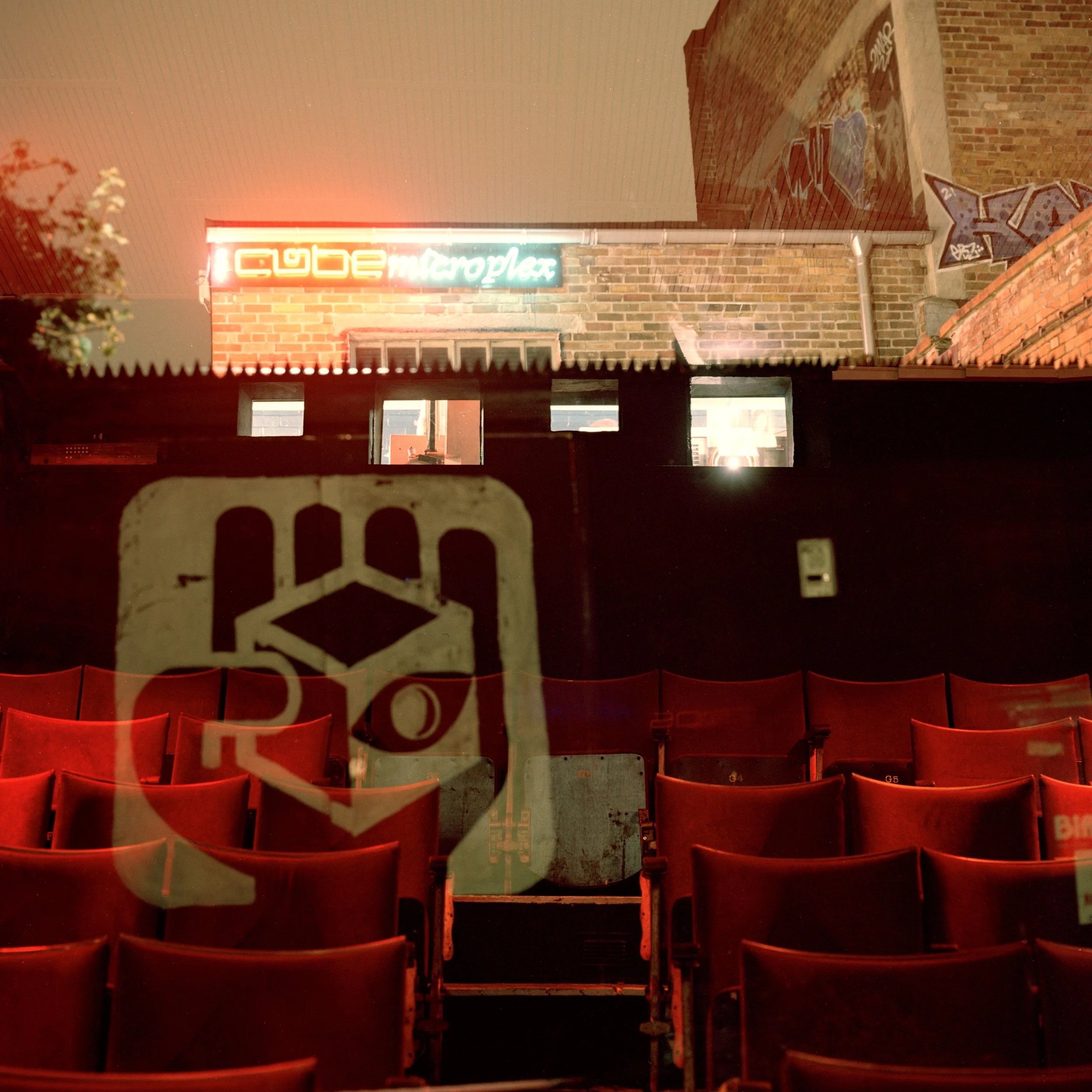
And this corner is where the ghost is usually seen…
says David ‘Hoppo’ Hopkinson without a speck of irony, as we cross the large echoing stage of The Cube Microplex cinema. To refer to The Cube as “only” a cinema would be an enormous oversight. Whilst the venue’s core programme is built around a rich and informed programme of art house and second-run films, international cinema, and what could variously be described as cult or occult movies – this is only the tip of the iceberg. The building plays host to Bristol’s most wayward concerts and performances, artistic experimentations, and community gatherings. A trip to The Cube could mean anything: B-movie schlock from the ’80s, drag cabaret, experimental noise concerts, puppet theatre, psychedelic projection spectacles, community workshops, or some gloriously unclassifiable hybrid of film screening, performance and late-night happening. The Cube is Bristol’s bastion of cultural oddities.
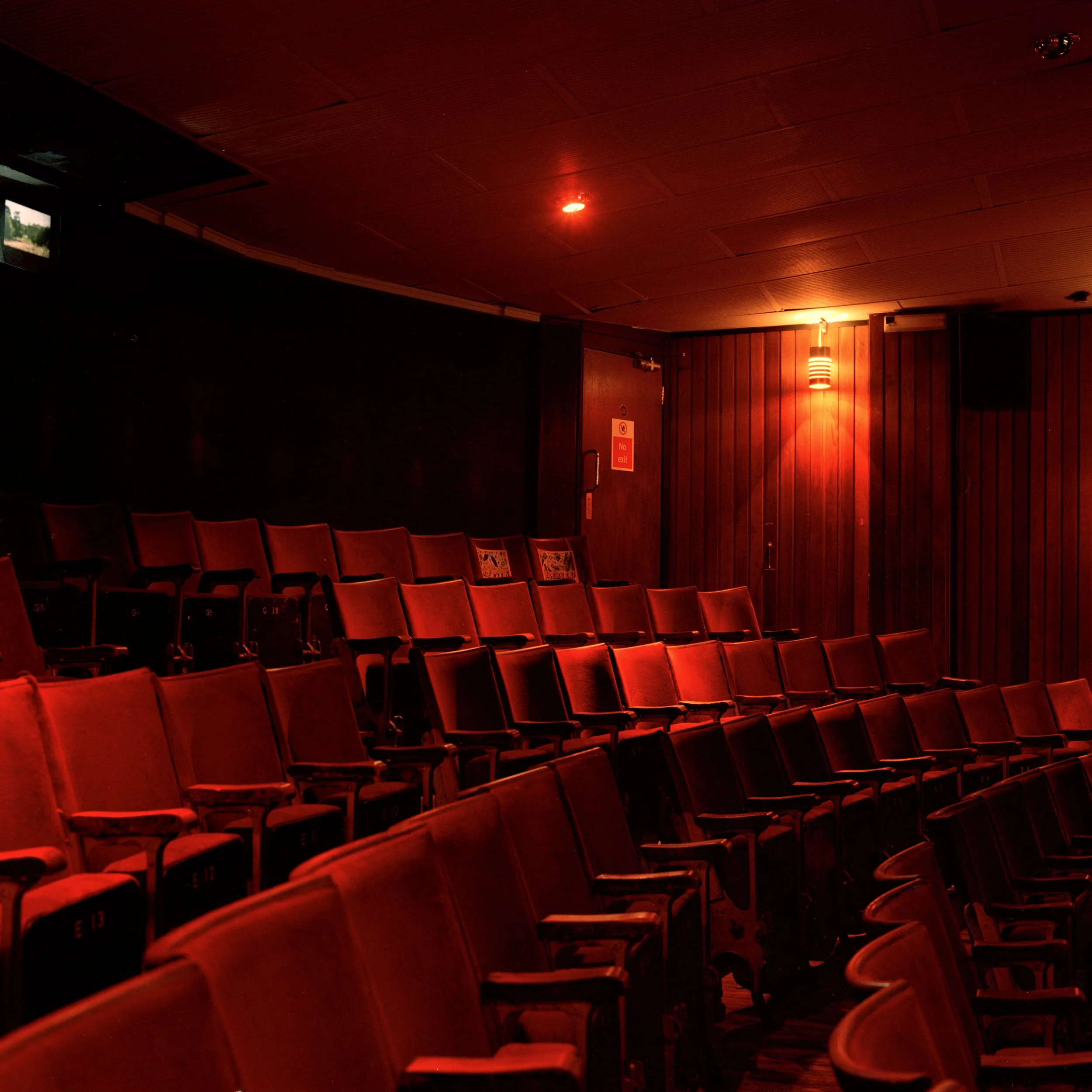
At present however, the stage is empty. The 100-seat wood-panelled auditorium is peacefully awaiting the next performance to grace the theatre stage-turned cinema. We had just been talking about flashbacks and hauntings – inevitable in a location steeped in history and memory.
It’s usually a blue, well-dressed figure that stands here and walks down the stairs under the stage.
This room is indeed haunted by a great many things. Haunted by the layers of stories created by the artists, performers, and volunteers that have come through the doors. The remnants are seen in every corner of the building: from the stacks of event posters crawling over each other on the labyrinthine walls, to the decades of old stickers and slogans memorialised on the bathroom tiles, to the piles of obsolete technology and video tapes of a million artistic projects that spill from the projection room like the tendrils of an ancient creature.
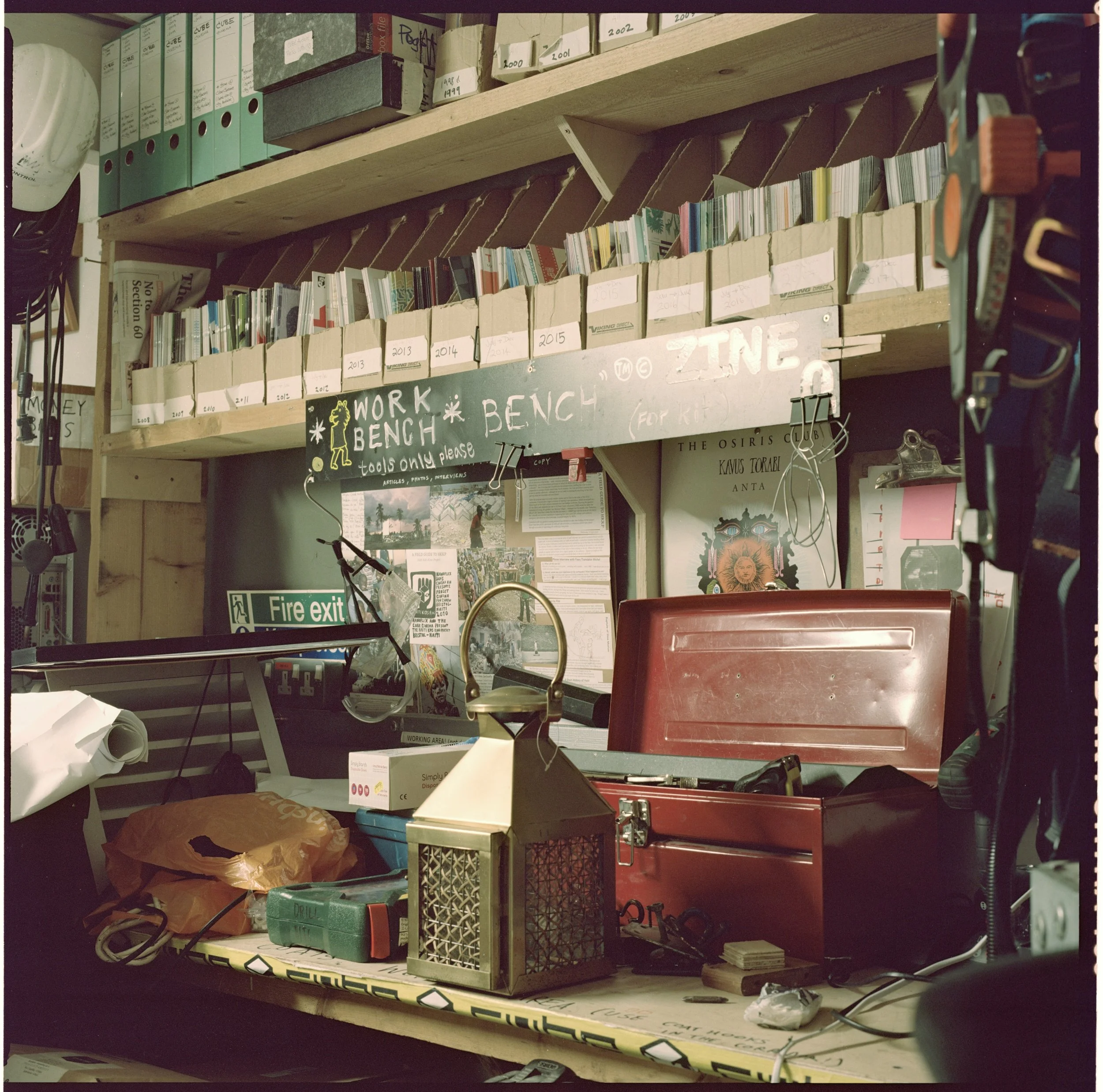
To tell me these stories, Hoppo is joined by Chiz Williams. Both men are long-time organisers at The Cube. Both were present at the outset in 1998, when the building became the free-spirited, collectively-run venue it is today.
Chiz: The good thing about The Cube is it relies on a lot of myths and fables. And stories that are quite powerful.
Here’s one of those stories:
In 1912, the building that would become The Cube started life as a bottle making factory owned by the Christian Mission, employing children with blindness and learning disabilities.
Here’s another:
In the 1960s, an arts centre was built in the amalgam of buildings of the old bottle factory. A stage, seating, and everything needed for a working theatre was bolted onto the existing structures. In that space, avant-garde artists set off fireworks and explosions on stage, burnt and destroyed sculptures in the name of auto-destructionist art, and hung obscene portraits of extreme performances in the bathrooms.
And one more:
In 1997, an ailing arts centre – hidden away down an interminably long corridor, past the toilets of a Chinese restaurant – shuts down. It was seized upon by a troupe of underground ravers and circus performers named Club Rombus. Toeing the “borderline of professionalism”, the troupe begins to haphazardly piece together a programme of film, sound experiments and performance, in between stints as a gambling den and sometime porn cinema. They call it “The Cube” – a shape that can hold anything it needs to hold, whenever it’s needed.

On the Trailing Edge
If you are an artist in Bristol, you have been to The Cube. You may have been brought there by a friend and been bewildered by the randomly stacked pieces of building that make up the venue. You have walked down the metal stairwell and passed posters for experimental reworks of even more experimental films. You have ascended the steps to the wooden panelled auditorium and picked out a red velvet chair in the layers of seating that orbit the black theatre stage like the ripples of a seashell. You’ve waited for the event to start and probably wondered if it’s going to be one of those Cube events – one of the “extra Cubey” ones.
When the wayward troupe of Club Rombus – coordinated by circus performers Graeme ‘Hogge’ Hogg and Kevin Dennis – took over the building from the fading Bristol Arts Centre in 1998, they brought with them an experimentalist ethos that remains as welcome and necessary today as it was then: to provide the city of Bristol with culture you won’t find anywhere else.
The building is one of those tragically rare spaces of genuine welcome, where audiences, volunteers and artists are indistinguishable from one another. It is a venue where anything that can happen will happen – unless it’s happened already. Though it is primarily a cinema with a remit of showing arthouse, experimental and second-run cinema, The Cube has built itself a programme that reads like a dadaist collage of event descriptions: puppet cabarets, kung-fu and disco jams, films played in reverse, robots playing earthenware bells, wilderness survival workshops, stripteases set to psychedelic projection art… As cultural spaces in cities across the country are dwindling and previously radical spaces become enveloped into enfranchisement, there is something almost magically and irrationally untouchable about The Cube: the most unsellable events sell out, unheard of film directors receive entire season runs, and through it all, the Cult of the Cube just keeps growing.
Chiz: We sometimes describe ourselves as “trailing edge”: Our events are almost so far behind the curve that people have lost track of it, and now they seem contemporary again.
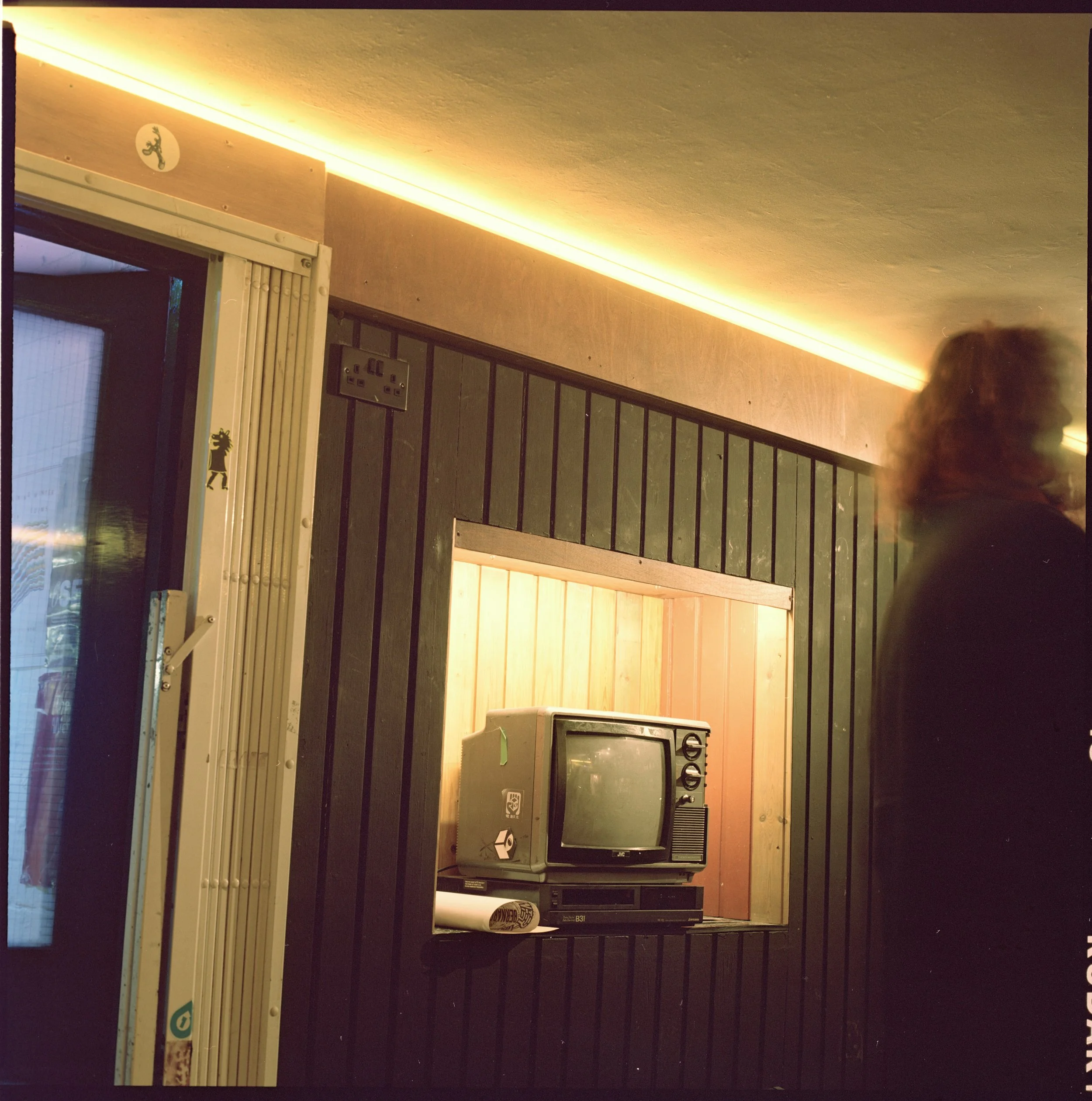
The true beauty of The Cube however, is not so much what happens onstage, or in the bar area, or what is scribbled or stickered on the walls – it’s how the venue runs and organises itself.
The Cube is an ongoing artwork that operates through the people that bring it to life. The building’s operation has been described as “politics in form”, meaning that the way the collective organises itself – the means by which the cinema is programmed and performances are organised – is in itself an expression of the venue’s inherent creativity and artistry.
Chiz: how we organised ourselves, how we run the bar, how we do everything not onstage. [...] The organisation of it is as important as the stuff that's happening in the auditorium.
When The Cube started, it was run by a crew of four people. In the decades since, the workforce has waxed and waned. There have been instances of volunteer numbers dropping in the past – for example, after a fire in the early 2000’s, or during the COVID pandemic – the current number sits somewhere around the three hundred and fifty, all volunteering their time, all feeding into the identity of the cinema, all with an equal voice in the way that the space is run. As Chiz and Hoppo tell me, the space is both enormous and tiny – a blank canvas of opportunity as well as a holding space and living room for those who need it. If The Cube is a shape that can hold it all, part of that versatility comes from the ability to shrink and expand as and when it's needed.
Chiz: It’s a massive building, it really is. And so people keep going “Oh, I can do this, I can do that, and that” and that’s massive for people who maybe feel that they don't have that in other parts of their lives.
Hoppo: But it’s also small. I think the particular proportions of the building is crucial, that’s my theory. Because I remember when it started, I wouldn’t have been surprised if it had ran successfully for only a year. But it just kept going. And I think it’s always been bubbling and cooking at just the right temperature, and at just the right size. People can pass through it, people leave and people join, and it just stays at this perfect level. There’s more volunteers than there is capacity in the space. Theoretically, when we have a volunteers meeting, everyone should potentially come, and they wouldn’t be able to fit in the space.
Chiz: It can exist with five people running it voluntarily, and now it’s got three hundred and fifty people. So it can contain that difference. It can shrink and contract – not unlimitedly of course – but within reason. The flexibility is insane.
If the old factory building is the body of The Cube, the volunteers are its blood, its lifeforce. Over the years, The Cube has offered space – not only for those seeking culture they wouldn’t find elsewhere, but also for those seeking a space to be – to find likeminded souls, and a space that allows artistic, professional, and personal experimentation. This is true for Hoppo, who was a video artist creating art in the nearby Jamaica Street Studios when The Cube was founded, and Chiz, who had just turned up in Bristol and was sleeping rough. Both men found in the nascent early days of the Cube a boundless space of potential.
Chiz: I had no money and so I was looking for a job. That’s why I knocked on the door, I was actually looking for employment – still today, one of The Cube’s major roles is employing people. And there doesn’t have to be a wage attached to it, but employment really provides people with a sense of purpose and something to look after. Something to manage. That was always a big thing for me. It was a place to do research, it was a place to meet people. There have been numerous people who have got together here and raised families, and not raised families. It was a place where people would buy food and share it, eat together. It was free entertainment. It’s always been a cheap bar.
It felt important to keep it because it was our livelihood, just without the finances… but it stopped us spending money.
Ed: I guess that’s a salary of sorts.
Chiz: It’s massive!
Hoppo: It subsidised us, as we subsidised it.
I could feel the influence that it was having because it was inspirational, not only to the people of Bristol, but we had artists and activists. You know, the Deaf Institute would come here and use it. We had the Palestinian Film Festival and the Jewish Film Club here in the same month. We’ve had refugees sleeping in The Cube, and people that are homeless. We’ve had people running away from cults and religious sects that have come here as a form of refuge and family.
We’ve never had to go and look for people to get in. People normally find The Cube.
Intentional Indeterminacy
Since one of the inherent tenets of the space is that it is completely voluntary and that everything that could be performed can be performed, a careful balancing act is maintained between total openness and total intentionality.
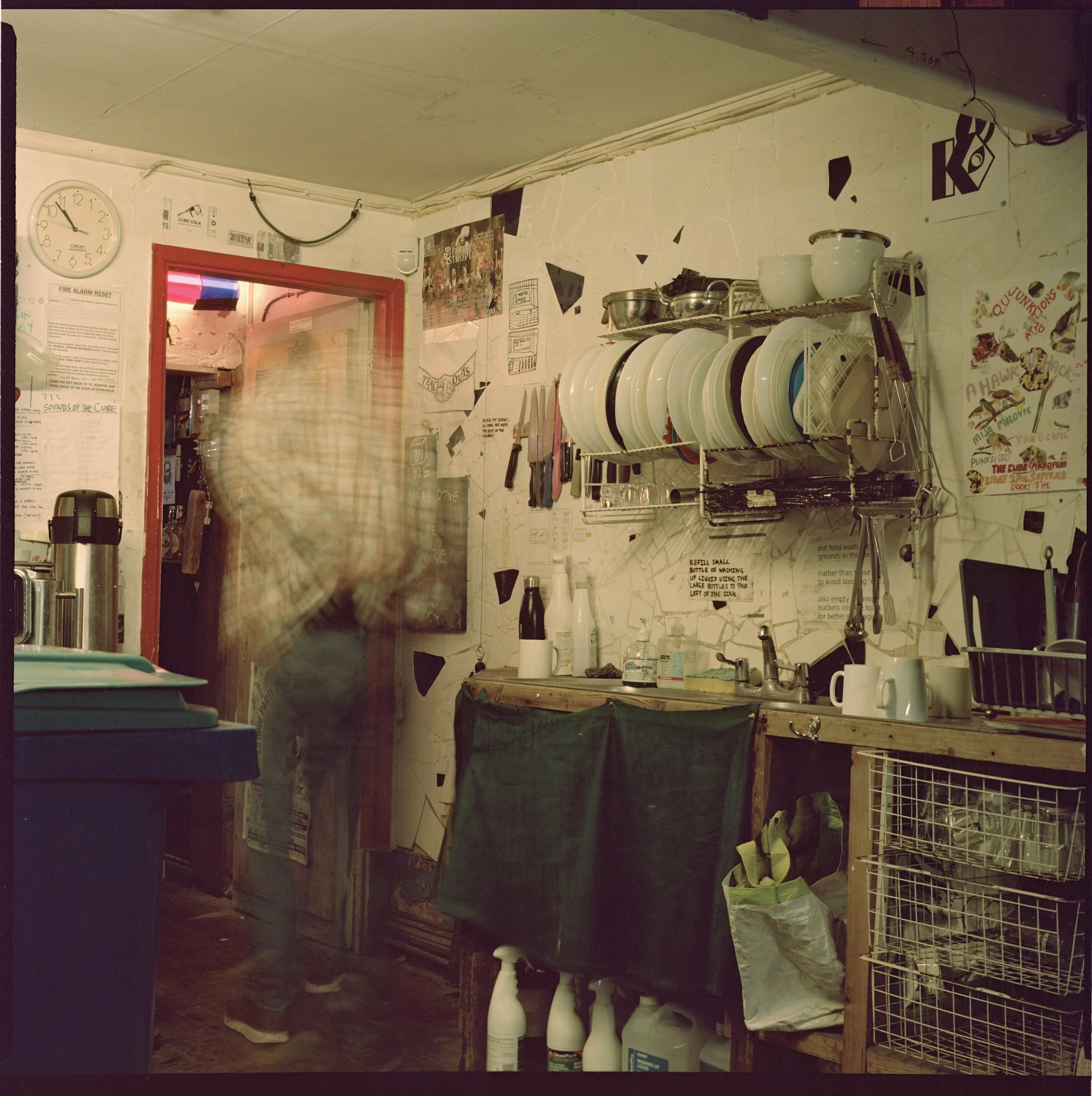
It’s a process that has gone under many iterations. In the early 2000’s the venue became the home to a radical exercise in democratic space-making via a foray into early intranet coding systems – a radical system wherein volunteers could freely and anonymously have input into which events would and wouldn’t be put on at The Cube, via a bespoke computer network built under the stage. Highly symbolic also is the creation of Cube Cola, an open-source recipe for a Coca-Cola developed by Kayle Brandon and Kate Rich in the early 2000’s. In total opposition to clandestine secret recipes of the Coca-Cola corporation, The Cube keeps its Cola recipe pinned to the wall in handwriting for all to see.
Underlying this collectivist ethos and open model is an implicit understanding that although the building is “owned” in the legal sense, The Cube is no one’s property. It is open access. It is the commons.
Chiz: How does it sustain itself properly? Well, we really really carefully consider everything we do. Everything. From the trees that are planted, to the drinks that we sell, to the way that we do our politics, everything. So it provides that kind of focus. The fact that it’s both got good intentions but it also has space for people to join in.
If you’re a volunteer you need to feel that you can give to it and develop it – and The Cube provides that. So it empowers the volunteer workforce so that people keep on returning. And then the audience comes because we’ve kept to our principles and kept to ideas of providing things that aren’t on offer elsewhere. We keep checking on that. Of course there are times when we break that intentionally
Hoppo: Or unintentionally…
Hoppo describes the programming process as “emergent”. Everyone is able to feed into the list of events that may be staged, and everyone is allowed to try out their own events. Additionally, the venue is of course hugely popular with those looking to perform works and shows that simply don't have a space elsewhere. But how does this deluge of choice result in a somewhat cohesive - or at least highly functional - events calendar?
Chiz: You have to respect the building, the land, the position within the city, and be vulnerable enough that you can figure out something that works within those restrictions. The Cube is always responsive to the moment. Because it’s not like an art gallery – it’s not programmed three years ahead, or a cinema where they’re programming just what’s financially successful to keep afloat – and what that does is it allows people to just respond with what’s in their hearts and what they’re feeling. It’s a big kind of sensory organ.
Hoppo: Yeah, it’s highly attuned to decency. We’ve had things like – we had SAD parties, you know, Seasonal Affective Disorder – because people were feeling sad they put on a party at The Cube and loads of other people came. We’ve had workshops on building homes in the woods because one person liked it and it turned out other people shared those interests. It’s never done through research, it just comes from people sensing it.
Ed: Is there a guiding philosophy to what gets put on?
Hoppo: I think one of them is what makes you laugh.
Chiz: Yeah. The sense of the absurd is quite, I would say, strong
Ed: I would agree.
Chiz: For some people it’s a chance to let loose. And that’s a big thing. It’s an acupuncture point in a sense. You know, it’s going to hurt a bit, it’s painful, but if you go with it and you trust it…
That’s why I think The Cube is a bit like a church – faith is a big thing. When people turn up here they’re not checked. When we do hires, we trust that we’ll get paid. And there’s a lot of faith in people and culture that something will come out of it, even if it seems ludicrous. We don’t go through a checklist of what it will provide, whether it will make money, we’ll often just go “yeah, that feels right.”
Hoppo: The Cube has never tried to be perfect. And I think when people try to aim for perfection, it has an effect, and the Cube can be self-righting in that way. It can go off kilter at times, but it does tend to right itself.
It’s a masterful exercise in knowing when to assert control and when to let go, in which the philosophy of trusting in the process has proven correct time and time again. It’s proof that when spaces of genuine community are fostered, and a stage is made to give home to people’s ideas, that community will take care of that space. During a programming meeting that I am allowed to sit in on, the unavoidable topic of venue fee comes up. “We take an artist's rate for the hire of the building” says Hoppo, “we treat the building as an artist.” The Cube both provides a home and shelter for artists and volunteers, and they, in turn, care for the walls of The Cube.

If there were ever a venue that typifies the word “palimpsest”, it’s the Cube. A “palimpsest” is a material that has been written on over and over and over; each time a new story is written upon it, the old story is wiped away and replaced – though traces of those old stories remain – until the material is covered in the vestiges of stories and memories piling on top of each other. The Cube is just such a place – a layering of histories and stories. Running like a common thread through all of these stories however is the consistent feeling of togetherness.
Chiz: All these things – from the deaf and blind socially conscious workforce, to a factory community, to the volunteers who built the stage, to the sense of mixing theatrical, film, mainstream, second run, art house, avant garde artists that were also working behind the bar. All that stuff is still the lifeblood of The Cube you know? I think it influences us in a way that we are sometimes unaware of.
The Cube building is indeed haunted, but its ghosts are those of years upon years of artistry, absurdism, and most importantly, a long standing history of communion.
For more information on The Cube, check out their website here.
Written by Ed Holland
Ed is a cultural essayist based in Bristol who writes about art, subcultures, and the cultural underground. He’s published work with Signifier and Psychic Garden, with recent essays exploring the counterculture in art history, protest iconography and artistic censorship, as well as interviewing members of the Bristol experimental music scene.
Photography by Louis Boyce
Louis Boyce is a visual artist based in Bristol, specialising in portraiture and events, and has a strong fascination with the cinema.
Website: https://louisb.photos/


Recipes