The 2 Sides of Tupac Shakur
Thirty years on from his untimely demise at the age of 25, Tupac Shakur is still one of the biggest names in hip hop, with his legacy far outliving his all too brief time producing music.
2026 is a more topical year than ever with the announcement that Tupac’s image will be appearing in digital form in game Stranger than Heaven in 2027, and with the long overdue trial and conviction of Duane ‘Keffe D’ Davis for his role in Tupac’s murder in Las Vegas on 7 September 1996. ‘Keffe D’ was sentenced to 40 years to life in prison on 13 October 2026.
Tupac was known for his insightful lyrics and keen social commentary, both in his music and in interviews.
But Tupac also faced scandal in his lifetime, including a trial for shooting two off-duty police officers in November 1993 (he was acquitted), a sexual assault trial in 1994 (he was convicted and given a custodial sentence the following year) and his involvement in the accidental shooting of a 6 year old boy, Qa’id Walker-Teal in 1992 (Tupac did not face criminal charges but did pay out a substantial sum in a civil lawsuit).
Across social media and Reddit forums, whilst some commenters are open to discussions, other die-hard fans passionately dismiss any slights upon Tupac’s name, but one could argue that he would not have been the Tupac they admire without all facets of his personality.
So, what makes Tupac such a divisive figure?
To properly answer this question, one has to consider the duality of both Tupac’s life and his music.
On the one hand, Tupac was a force for good, campaigning for racial and gender equality, both in interviews and in songs such as Brenda’s Got a Baby.
In his earlier work, Tupac used his lyrics to speak about issues that were important to young African Americans growing up in 1990s America, heavily influenced by his mother Afeni’s involvement through the Black Panthers with the Black liberation movement.
His work was honest and autobiographical, as demonstrated in songs like Dear Mama. He used his platform in an effort to empower Black women facing social injustice, poverty and domestic struggles, with songs such as Keep Ya Head Up, and to uplift Black youth and steer them away from gangs and crime in songs like Changes (recorded by Tupac in 1992, but posthumously released in 1998).
He lived his early life in accordance with his values, reading prolifically, studying acting at the Baltimore School for the Arts (BSA) and seeking respite in poetry and music when his mother’s drug addiction led to an increasingly transient lifestyle.
Friends and family commented on how much Tupac hated to see injustice, and how he wanted to continue his mother’s efforts to build a better America for Black youth.
However, later albums focused more heavily on the East vs West Coast rivalry, stepping away from the political commentary and autobiographical undertones that characterised his earlier work, and ironically promoting the objectification of women in tracks like I Get Around and glorifying the gangster lifestyle and violence in songs like Hit Em Up, Ambitionz Az a Ridah and No More Pain.
Another source of irony was that, whilst Tupac’s affiliations with Suge Knight and his label Death Row Records and Tupac’s move at the age of 17 to California placed him in the West Coast camp, he was in fact born and raised on the East Coast in New York.
Tupac’s publicist and close friend, Karen Lee, who had known Tupac since his childhood, confronted Tupac when he released hip-hop diss track Hit Em Up, telling him, “I wanna speak to the guy who wrote Brenda’s Got a Baby and Keep Ya Head Up, because I don’t know who this person is who wrote this sh*t.”
On this hand, Tupac glorified gangland culture – promoting the East vs West Coast rivalry narrative and objectifying women – and even served time in prison for gender violence (his appeal against this conviction was still pending at the time of his death).
The murder conviction of Keffe D on 31 August 2026 of Duane ‘Keffe D’ Davis substantiates the proposition that Tupac’s death was gang-related retaliation for an attack on Keffe D’s nephew, Compton Crip member Orlando Anderson. That attack had been led by Tupac alongside Death Row Records/Blood gang-affiliated associates in the Las Vegas MGM Grand, mere hours before Tupac’s murder. In the days that followed Tupac’s murder, there was a wave of ‘tit for tat’ gang shootings in Compton.
Tupac was a complicated person, who enjoyed poetry, the art of Vincent van Gogh (Don McLean’s song Vincent (Starry, Starry Night was one of his favourites), had eclectic musical tastes and enjoyed watching musicals such as Les Miserables, whilst also embracing the gangster lifestyle, getting caught up in civil and criminal cases, and being notoriously hot-headed (Tupac acknowledged in a 1994 MTV News interview, “I got a big mouth, can’t help it. I talk from my heart, I’m real.”)
Whilst always recording in the hip hop genre, there is a noticeable contrast between the lyrics of Tupac’s earliest works compared to his later ones.
The contrasting themes of Tupac’s music reflected the direction of his focus at that time – his early work was heavily influenced by his mother Afeni and her political teachings, whereas in his later work, he leant into the grit and glamour of the gangster lifestyle, collaborating with other artists from Death Row Records (for instance, Snoop Dogg on 2 of Amerikaz Most Wanted and Dr Dre on California Love) who espoused similar views.
Throughout it all, even while outwardly his later work and the language used in interviews appeared more divisive, particularly where the West Coast vs East Coast rivalry was concerned, behind the scenes Tupac was still trying to unite and empower Black youth, using his status within the recording industry to provide a platform for the young hip-hop collective Outlawz (known at one point as Dramacydal) that he founded in 1995, and whose members had featured on his music since 1993.
On occasion, even early in his career, Tupac’s intentions were misinterpreted.
For example, the protagonist in Tupac’s song Soulja’s Story shoots a police officer before ultimately losing his own life to gun violence. When Ronald Ray Howard fatally shot Texas Department of Public Safety trooper Bill Davidson in 1992, his defence lawyer claimed that Howard had been influenced by Tupac’s lyrics on 2Pacalyspe Now, specifically Soulja’s Story.
But as Tupac explained to Tom Whalley, the founder of his then record label Interscope, the song is not a directive for people to shoot police officers – rather, it was a commentary on the disillusionment experienced by young Black males, and a representation of their feelings in the face of disproportionate police harassment.
If anything, Soulja’s Story is a cautionary tale. It is also a good illustration of the point that not everything that is said in rap music (or any genre, for that matter) is meant to be taken literally – as Eminem (who has called Tupac a ‘true genius’ and ‘a superstar in every sense of the word’) pointed out in his track Sing for the Moment: ‘It’s all political, if my music is literal and I’m a criminal, how the f*** can I raise a little girl?’
Tupac’s Thug Life movement was also perceived as a glorification of violence. Tupac’s godfather Jamal Joseph, a former Black Panther and member of the Black Liberation Army, had warned Tupac that using the word ‘thug’ and its negative connotations could be ‘misconstrued by the general population’.
Having a bullet in place of the ‘I’ in his infamous Thug Life tattoo did not assist with this misconception, but Tupac insisted that he was trying to reclaim the word ‘thug’ (just as Black people had reclaimed the racial slur n***** by altering its spelling and usage), and that THUG LIFE was an acronym for ‘The Hate U Give Little Infants F***s Everybody’, representing a form of social commentary and highlighting the impact of systemic oppression rather than glorifying crime.
Nevertheless, the timing of the Thug Life movement alongside the height of the East Coast vs West Coast war was unfortunate, and whilst serving his prison sentence at Rikers Island in 1995, Tupac vowed to renounce Thug Life, telling Kevin Powell in an interview for Vibe magazine, “Thug Life to me is dead… I’m going to show people my true intentions, and my true heart. I’m going to show them the man that my mother raised. I’m going to make them all proud.”
Tupac was clearly a very intelligent logophile with a keen grasp of language and politics, who has been hugely influential to the rappers following in his wake (such as Eminem, Drake, Cardi B, Kendrick Lamar and The Game), but he also made several poor decisions, one of which ultimately cost him his life.
One can’t help but wonder, if Tupac had lived longer, would he have reverted to focusing more exclusively on his political persuasions, or if would he have pivoted in a completely different direction?
Tupac’s contemporary Snoop Dogg, whilst staying true to his hip hop roots in the majority of his creative output, has collaborated musically with pop artists like Katy Perry, Justin Bieber and The Pussycat Dolls, and crossed over into more mainstream output with his role as a judge on TV show The Voice, and family friendly fare with the creation of his animated series Doggyland and his voice acting role in PAW Patrol: The Dino Movie.
Like Snoop Dogg (formerly Snoop Rock, DJ Snoopaholic and Snoop Doggy Dogg), Tupac was constantly reinventing his musical identity – before his passing, Tupac had begun using the stage name Makaveli and had renamed his protégé group ‘the Outlaw Immortalz’, giving them professional aliases themed around ‘people that we know this country despises’ (such as Benito Mussolini, Idi Amin and Fidel Castro) as a political statement – ‘because we feel as the young Black males we are despised in this country’ (as explained by E. D. I. Mean in his 2015 interview with Vlad TV).
In his personal life in the months preceding his demise, whilst still working hard and recording prolifically, Tupac was more settled, forming a committed relationship with Kidada Jones and leasing property in Calabasas, California for himself, his family and close friends.
With his premature death, we can only speculate as to what Tupac would have been doing if he were still alive today.
What is indisputable is that 30 years on from his passing, Tupac’s legacy continues.
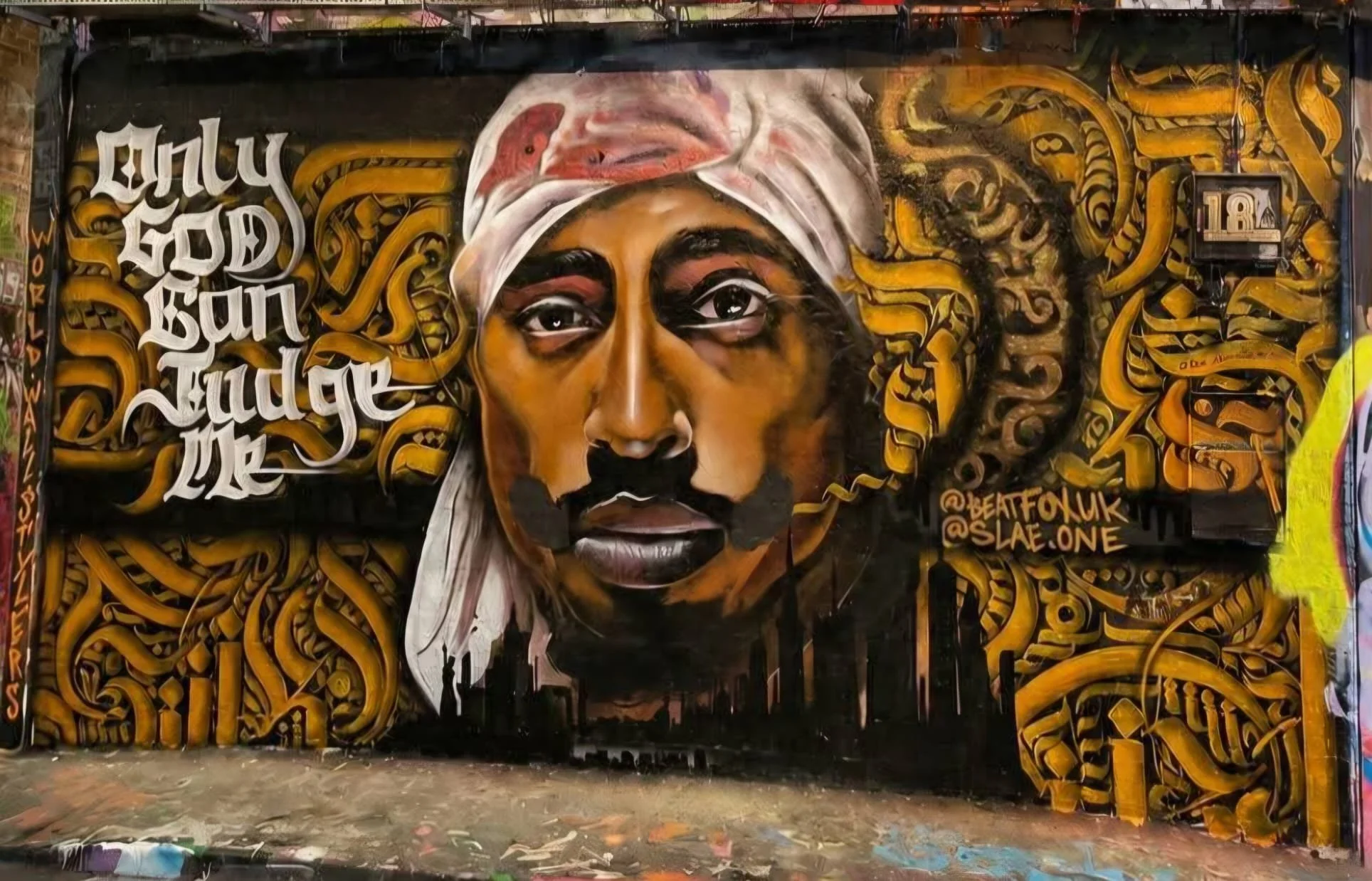
Credit: Lost Places & Forgotten Faces
Even those who are not fans of Tupac and/or his songs can appreciate the indelible mark he has left on the hip hop industry and his wide-reaching appeal. Tupac deployed his acting skills in films such as Juice, Above the Rim and Poetic Justice, and his double album (a hip hop first), All Eyez on Me, sold over 5 million copies.
Despite the arguably polarising nature of his later work, Tupac’s work ethic was undisputedly unparallelled, as is evidenced by the volume of musical output (6 albums, including Thug Life: Volume 1 with his group Thug Life and The Don Killuminati: The 7 Day Theory – released posthumously but fully completed before Tupac’s death) in just 5 years of recording. Tupac produced enough further material for another 6 posthumous album releases.
Throughout his career and posthumously, Tupac has sold over 75 million records worldwide.
Jeffrey Ogbar, history professor and founding director of the Center for the Study of Popular Music at the University of Connecticut, astutely observed that the duality of Tupac’s personality “allows us to, in some ways, pick and choose what part of his politics we want to amplify”.
There will always be those who choose to focus on Tupac as an ‘East Coast gangster icon’ – and for these fans, Tupac’s inclusion in Stranger than Heaven likely feels like a good fit for their interpretation of the Tupac brand.
Others choose to focus upon Tupac’s role as an ‘actor-rapper-activist’, using his artistic platform as a means to make politics accessible to the masses.
The truth is, Tupac was all of these things.
Jeff Pearlman, author of Tupac biography Only God Can Judge Me, described Tupac as ‘brilliant and gifted’ but also a ‘tragic figure’ who ‘should be here living life’ and ‘speaking out against the ICE raids.’
Staci Robinson, author of Tupac Shakur – The Authorised Biography, described Tupac as ‘a man driven by equal parts brilliance and impulsiveness.’
Both authors researched their books extensively and spoke openly within them about both the positive and negative aspects of Tupac’s life, with palpable admiration for Shakur, demonstrating perfectly that acknowledging Tupac’s human fallibility does not detract from our ability to continue appreciating his political and musical legacy.
Written by Michelle Peet



Opinion