Somewhere Between Here and Home: Bike-packing from England, across to France and Belgium
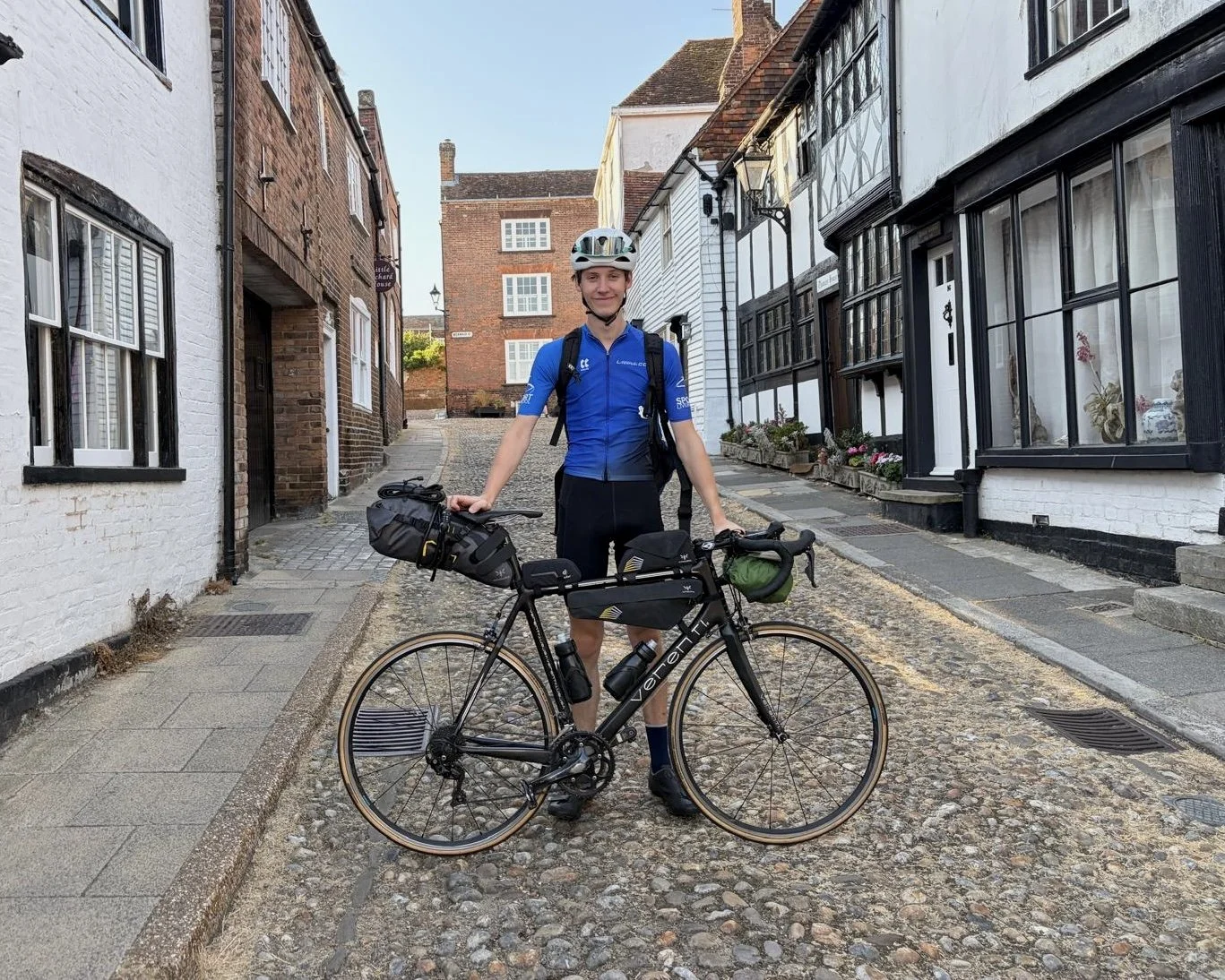
It’s approximately 6:30am on a Tuesday morning in August. Already, two things feel out of place, as I’m not asleep and I’m not at home. Rather, I’m somewhere between sleep and wakefulness, walking around a holiday home in the small town of Rye in East Sussex, periodically checking my bike to make sure I do actually have what I need, and contemplating spending four days with bike cleats and flip flops as my sole footwear options.
I’d spent the last few months convincing myself to go away on my own; a first solo holiday of sorts, taking my bike, tent and now fairly nervous self away first to France, then Belgium, then home again via France. Now, as I plod around the kitchen with a bowl of porridge in one hand and a heart rate monitor in the other, it’s actually happening.
The idea came about after seeing innumerable videos and posts online about the excitement of solo adventuring, which spurred on the thought of ‘I can do that, can’t I?’. I spent a while getting giddy about what routes I could take, some entirely silly in length before finding something sensible. Before long, I was booking ferries and campsites, taking a train down to Rye where I’d begin my journey, and suddenly it all existed.
Nerves played a larger role on the day (more of which I’ll touch on later), but to begin with it was excitement at centre stage. The idea I could do something, to again push myself out of my comfort zone, felt fresh.
As I tighten the last straps on my weighty saddlebag, take some obligatory start-line photos and roll down the first of many roads, it was this preliminary excitement that came back. I’m doing something cool.
To my surprise, much of that first day passed with relative ease. Where I’d expected pangs of fear, there was mental quiet as the Sussex lanes passed by with little strain. The first leg of the day would take me to Dover port, where I’d journey over to Dunkerque. A little over 30 miles of flat roads were appreciated as I soon realised ‘Wow, this bike weighs a lot more now!’. With the help of some podcasts this first section flew by, disturbed only by the sight, and laborious climbing of, the hills into Folkestone and then Dover. Before I knew it, I was off the bike and waiting in line at the ticket office. Here, I’d enjoy the first instance of what would come to be a crucial element of this trip, personally; moments of small talk with strangers. Waiting behind me were a Belgian family, all clad in similar lycra to me but with bikes that looked twice the size. Upon chatting, they revealed that they were coming home from a journey across the South Coast to Cornwall and back, and that this was nothing unusual even for their two small children. We said our goodbyes and already I had appreciated the fact, more so than before, that I’d had a brief window into a stranger’s life just by asking where they were going.
Like the lanes that preceded, the ferry crossing itself ran entirely uneventfully and, once again, I was on the road. Fuelled by a decidedly mediocre curry and chips, I pedalled on for another 20 miles to reach the first campsite. Just like home lanes, these were flat and stretched openly into the distance, long farmland roads that passed the occasional farmhouse but otherwise remained undisturbed. The feeling remained well until I reached the campsite. Buried down a seemingly nameless track were a few tents overshadowed by a larger house. This was my first stop. I met the owner who took me to my pitch and began to unpack. It was here that some first inklings of panic took over; as I’d stopped physically moving, everything else mental had caught up all at once. What am I doing? I’m really on my own now. I’m in France, I can’t speak much French. I started to miss home comforts as, after setting up the tent and rolling into the next town over, I realised no restaurants were open tonight and I had no food. Alas, in stepped a family classic; supermarket dinner comprising of a baguette, Leerdammer cheese, ham and some fresh fruit. This pang of stress that I’d felt upon arriving continued relatively unabated for the rest of the night, and felt similar to what I’d experienced when starting university, the idea of being without access to the familiar and everyday.
The next day soon came and with it more chances for something new to be seen. I chatted again with some campers from Cornwall who had pitched up late last night. They told me about their trip to Amsterdam and I told them of what I had planned, remembering that I really will talk about my bike to anyone that will listen. I had mentioned the night before anticipating some sleep trouble as I’m not a natural camper. To my surprise, the lad I was speaking to gave me a spare eye mask, noting that it really helped him at times. Again, through talking to new people in an uncomfortable environment I’d found a sense of human connection in an unfamiliar place. I was pleased to see that the effort I’d put in did bear rewards – not in the receiving of the eye mask itself, but that a stranger would do something kind for me.
I hoped to carry this good start onwards. The day held more excitement; I’d be riding around 60 miles total, with a perfect halfway point being the Belgian city of Ypres, somewhere I’d wanted to go on a previous holiday but didn’t find the time.
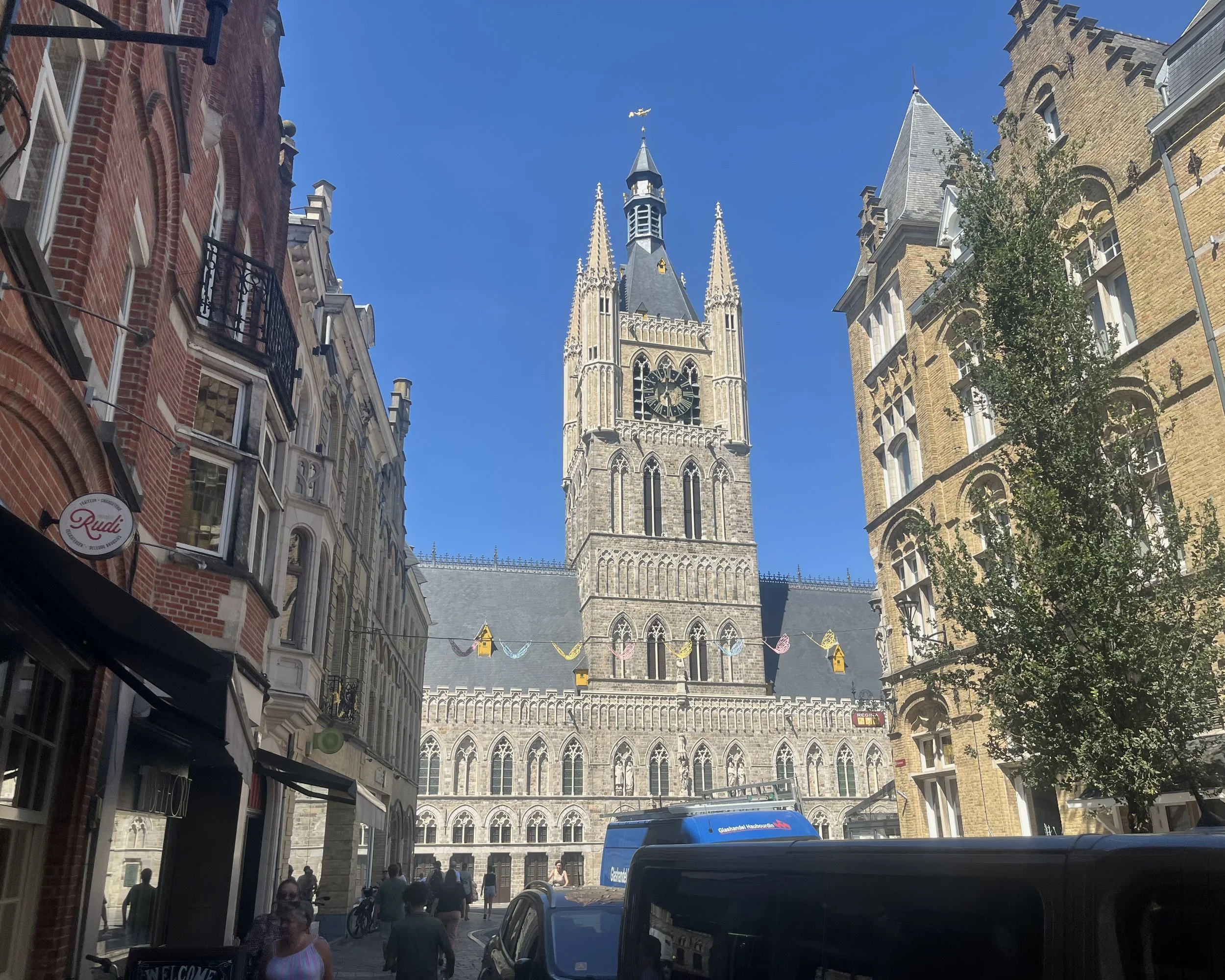
I found my first stop in Poperinge, one of the larger towns on my route that featured a beautiful town square in true Flandrien style with gothic, ornate architecture on the church and town hall. Here I met James, who I waved over to help pump my tyre. I found out that he’d ridden his bike all across Europe since April, even stopping off for a month in Vienna with friends and was slowly making his way back to Ireland. His bike had a gear cassette the size of a dinner plate and he’d put E-Bike tyres on to avoid punctures, along with carrying so much equipment you could hardly see the bike frame. We went separate ways in the end but I noticed again how much I appreciated this interaction, as relatively short as it was, as a force of self-sustenance on the day. Another few miles and I was in Ypres. The city was a joy, if smaller than expected. Each street bore the same narrow, terraced townhouses that seemed to spring with features of Flandrien architecture. Within a few minutes of entering, I found myself at the Menin Gate, which a friendly Belgian couple aptly described as the ‘Main Event’.
The friendliness of the city’s people stuck out immediately. I chatted with the aforementioned couple while eating a cheese toastie and admiring the town. Following on, I tried my luck at a local bike shop, who allowed me to use their workshop to pump my tyres (the previous attempt had failed miserably). As I decided it was time for more food, I visited a patisserie where the attendant joked with me, mistaking me for being Belgian myself, before recommending a ‘Spletter’, a local vanilla-filled waffle. Within Ypres and the rest of the day I’d seen in clear form the reason why I’d wanted to come away on my own; to be somewhere I’d find inherently challenging and to see these small instances of kindness and interaction which would spur me on. This theme of the day would continue in further encounters; upon reaching the night’s campsite, I spoke with the manager in his admittedly more comprehensive English than my floundering French, who then dubbed himself ‘Le Whiz’ as he operated the computer’s booking spreadsheets. I later passed an elderly man on a bicycle further into France, who called on ‘Bonne chance!’ as he saw me disappear. Then there was the elderly couple at the campsite who said goodnight to me each time I walked past, though we’d never met, and in the morning gleefully waved goodbye. The more I put myself out there, the more I saw returned to me, and while these instances were only small and in isolation, merely facets of the everyday life I have already, to see them again where I’d expected such difficulty was calming. My day’s excursion into Belgium and back into France couldn’t have gone better.
The rest of the trip followed status quo. That is, a rising and falling of nerves met each time by long periods of distraction as I found a rhythmic peace in each spin of the legs. The French roads remained hot and long, exactly as I’d known them. The culmination of my next day’s efforts was reaching the town of Boulogne-sur-Mer, returning to the northern coast where I began to feel a conclusion of my efforts approaching. I woke again the next two days early in the morning, packing and setting out before nine to appreciate some bluntness of the sun before it rose truly. I learnt lessons about hydrating and eating on such days (I didn’t do enough of either, as some stops underneath shaded motorway overpasses reminded me). I learnt how to manage a small crisis, when my phone charger broke and phone then died, with no backup. I took myself to dinner, in a town I didn’t know, who spoke a language I was decidedly amateur at. While the stress of the event didn’t entirely clear, I was able to recognise it for its passing nature, and in that see contentment when it would pass. While it had the eponymous title of ‘bikepacking trip’, where I’d foregrounded the bike riding element of it, this became valuable for me as a practice of stress-management above all else.
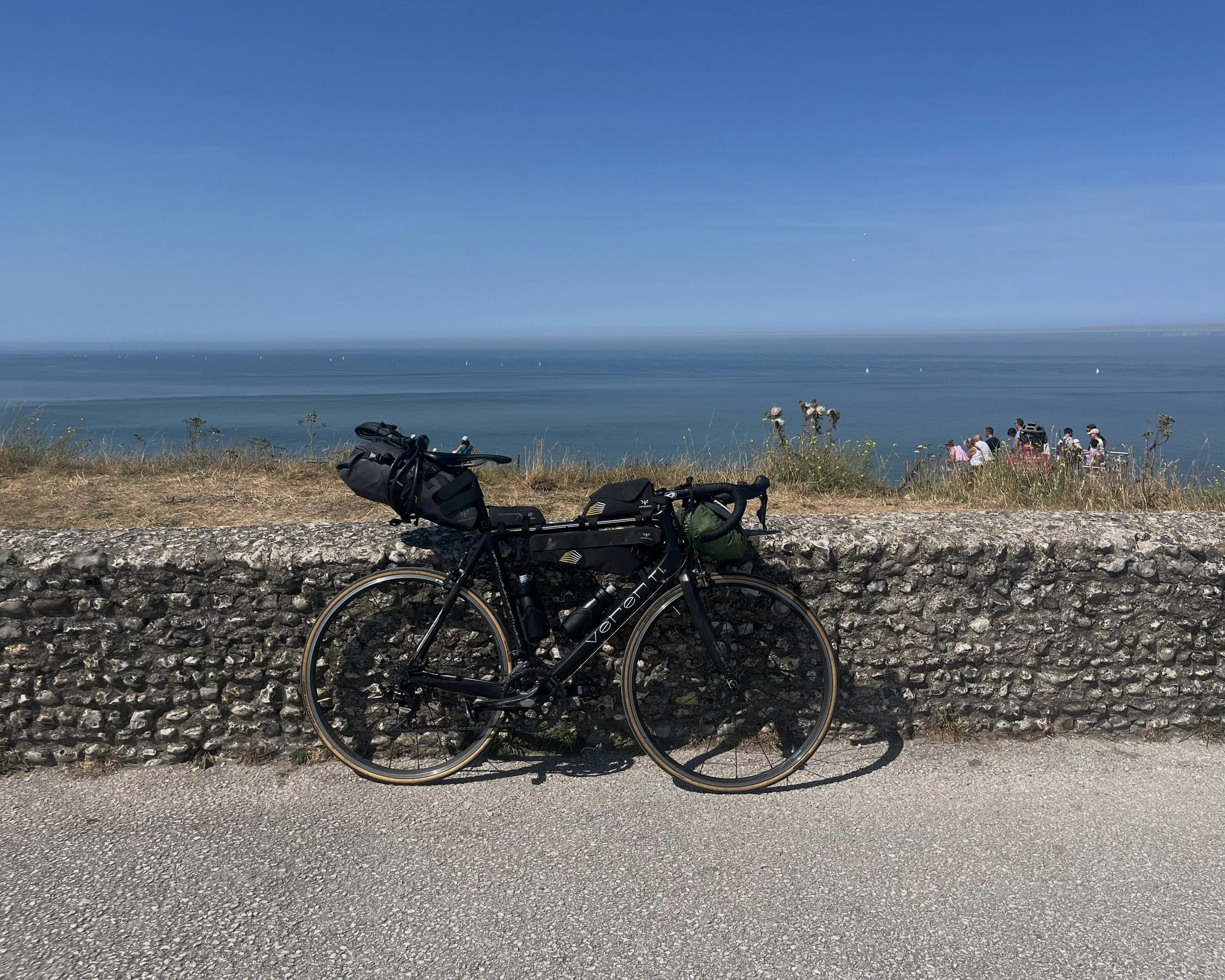
The last day’s job was simple. Ride bike up the coast, reach Calais, cross on ferry, ride bike home. A mission-in-reverse of day one. I breakfasted in town before much of the town woke, flip-flopping around the now empty streets, calmly revisiting the sites of the previous night’s stresses. Packed up, I joined the carriageway that would take me out of town and was quietly proud sitting in the knowledge that this would take me up the coast and home. The roads began to empty out and only clear skies lay above. I soon descended fast down to the commune of Escalles, atop of which sat the Cap Blanc-Nez. Ten minutes of grinding effort (the bike now had an additional invisible anchor found in my legs) and I reached the top. From here I could see Calais and England. I sat beside a monument and ate some of earlier’s leftover croissants, knowing with a satisfaction that I was almost done.
Back in England, my pride had dissipated somewhat and was replaced with pain, the pain of near 250 miles riding in a few days. In what became a slog to return from ferry to home the same flat roads I’d taken on the way out seemed to bite with a veiled incline. The pedals seemed to pinch at my feet, which ran up my legs and back, finding finally my aching neck. Through the aches, I began to retrace the now-familiar roads, as Rye finally approached. I climbed the last steep cobbled road (a rude joke to culminate the mostly-flat days I’d spent), saw again our front door, knocked and sat down.
The relatively little time I’d spent on my own, just four days total, had felt deceiving by its enormity. It existed so out of the ordinary for me that the stress I felt was inevitable. And though, in reality, it was only short, it had been hugely valuable. A common antidote to that stress were the little moments of interaction I’d found, often unexpected and always encouraging. I saw then, and still do now, real importance in the challenge, treating it as an exercise in independence. Where it’s now all too easy to become confined in our online worlds, with faux connection found in each scroll, the trip felt like a step towards reclaiming myself from distraction, one turn of the pedals at a time.
I just wouldn’t do it in August again.
Written by Lewis Webb