Street Art and Graffiti in a Rural Town: From Additive to Transformative
“I hope you’re going to repaint the whole thing”, a stranger snapped as she nuzzled into her coat and flippantly gestured to the tunnel walls around us. This indiscriminate rejection of the graffiti and street art covering them cut through the intentional curiosity and careful consideration of the colour, composition and layering of the pieces that we had carried all afternoon. I recruited Billy Cook to photograph street art and graffiti in our rural hometown of Ringwood, and this was our final location. Earlier that afternoon, we had left the photography shop on the corner of the high street carrying coffees and a fresh roll of film for Billy’s Nikon FM2, now my coffee was cold and we were coming to the end of the roll. We had walked between the small, concentrated list of potential street art and graffiti locations.
The near absence of street art and graffiti here is especially noticeable to me after living in large cities where it seemingly filled all available space. Creating a photographic archive of street art and graffiti in Ringwood, as a rural town, feels less like capturing pieces, but honouring them. It is not only highlighting a cultural and creative landscape that exists but often goes unnoticed or deemed less influential outside of the metropole, but it is also entangled in generating Ringwood’s identity. As part of this exploration into street art and graffiti in rural towns, I signed Ringwood up to ‘Street Art Cities’ a website that maps street art across the UK. Ringwood is officially on the map. By placing Ringwood into this visually focused space, it asserts its (potential) artistic or creative visual identity, even if it is minimal or contested. Using an archival map, I hope to both document and advocate for further understanding of how street art functions in rural spaces. The site explicitly maps street art, not graffiti. However, here I will discuss the interplay between the two practices in Ringwood’s context.
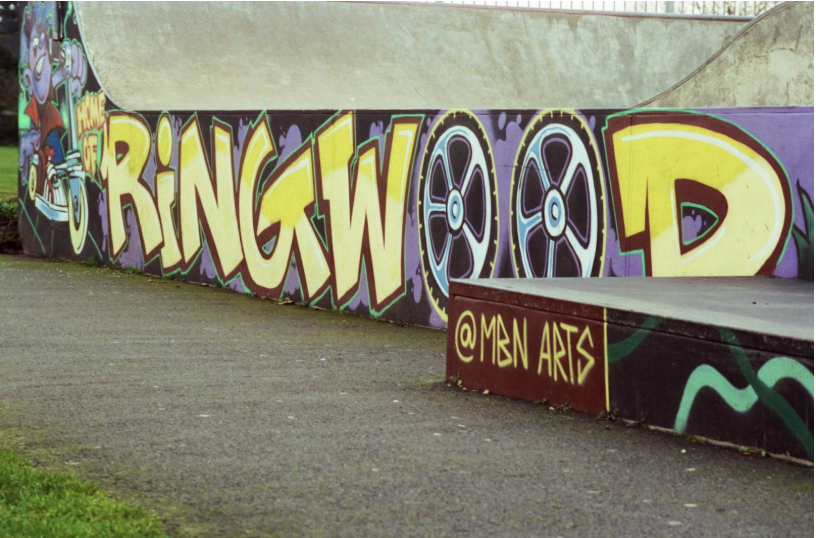
Photograph by Billy Cook, 2026. Art by @MBNARTS
“Walls are where people have looked for centuries to gauge public reactions to and personal perspectives on major events that cannot be left to those in power to convey.” - Stefano Bloch
Walls are used to engage with space, to make a mark or express an idea - we can understand this as ‘place-making’. A ‘place-making’ device is used as a form of creative expression that reclaims the identity of a place or its inhabitants. This bottom-up practice spans across time and culture. Graffiti is generally understood as an urban practice of graphic lettering, that subverts common understandings of art and space. Usually it is unsanctioned or illegal. On the other hand, street art is a different cultural practice that does not necessarily transgress or resist norms and is not necessarily considered ‘sub-culture’ (but it can be). Street art tends to look like illustrative artworks using techniques such as stencils, paste-ups or stickers. It is both sanctioned and unsanctioned, commissioned and uncommissioned, a sellable commodity or a social problem. The distinction between street art and graffiti matters in Ringwood because there are examples of both, yet it is their proximity and interplay that changes how they function in the space, specifically against the rural backdrop of this town.
My enquiry began after reading about the refreshed skate park on Carvers field, as pictured here. This piece was commissioned by Ringwood Town Council and created by MBN Arts. MBN arts is an educational organisation based in Bournemouth and offers an alternative artistic education to neurodiverse and emotionally vulnerable children. This organisation actively builds inclusive space, using art as a tool to co-create community. On the surface, commissioning an artist to paint the town’s name in graffiti lettering on the side of a newly built skate park is giving the same energy as purposefully ripped Balenciaga jeans. It can feel like commissioned street art is performing identity, rather than producing it. Conveniently, it also limits the space the skate park users can graffiti themselves, making it not just a way of aestheticising the space, but of containing it. Despite my initial rejection of its inorganic origin, I can’t deny that the presence of this piece feels disproportionately loud against Ringwood’s bare walls. A group of young boys were learning new moves on the skate park, cheering each other on and playing. “Ringwood Riders” framed their performance. Upon learning about MBN Arts, the piece began to feel like an open invitation for these young boys to be part of a group, and, perhaps, a part of their town - it purposefully welcomes new, perhaps alternative identities, honouring the cultural identity of skate parks as a place graffiti should be.
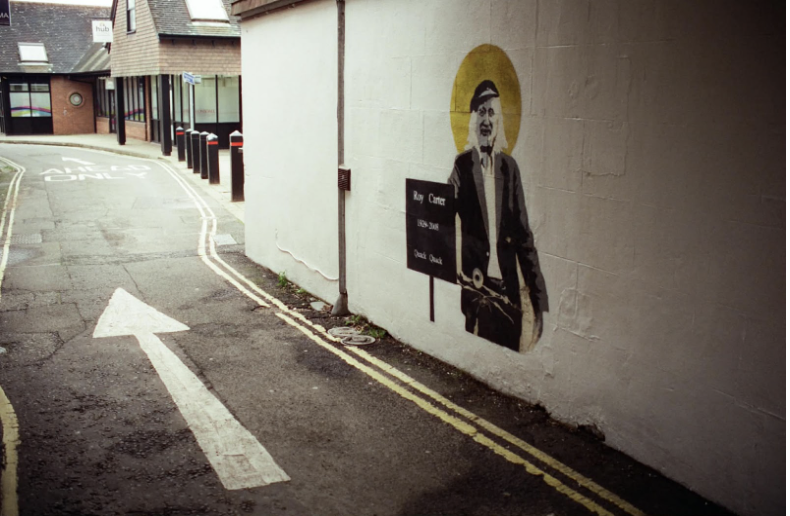
Photograph by Billy Cook, 2026
Overcast and heavy, Billy and I agree the sky feels representative of England today. Though, the scene is quickly brightened by the friendly smile of Roy Walker captured in this commemorative mural. Better known to locals as ‘Catweazle’, Roy would cycle around the town calling ‘hello’ and ‘quack quack’ to passers by. His days were spent within the streets and this commemoration fittingly represents and continues that legacy. This piece is an appropriate expression of the town’s grief, joy and gratitude to this well-known and well-loved character. It speaks to the sense of community that often fuels why people are drawn to living in rural areas and shows how street art can tell the story of the town.
Photograph by Billy Cook, 2026
Photograph by Billy Cook, 2026
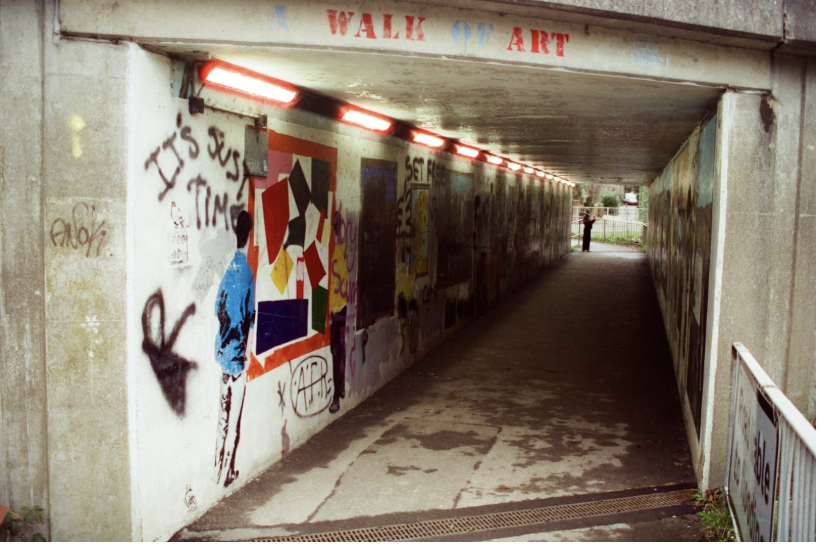
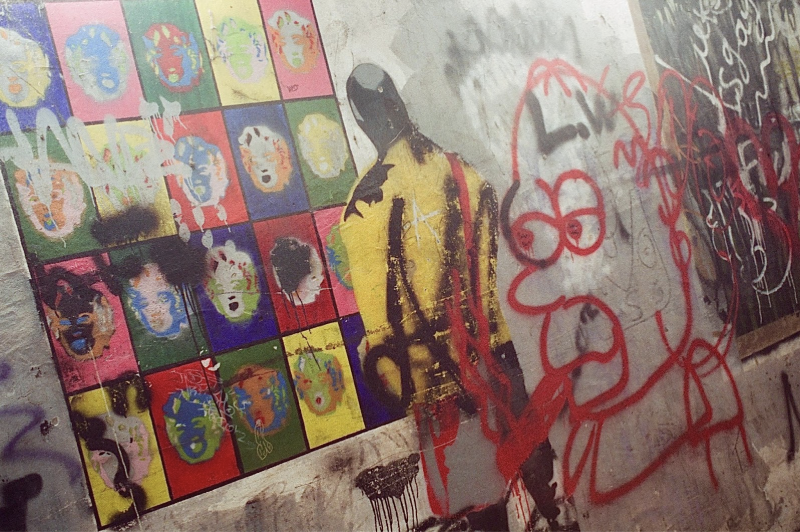
‘The Walk of Art’ is a small tunnel that crosses under the A31, a road that tears through the middle of Ringwood. The Town Council commissioned art students from the local school to create a display in the tunnel, earning its name. Now, large 2m x 2m renditions of iconic pieces such as Andy Warhol’s ‘Marilyn Diptych’ and Matisse’s ‘Blue Nude II’ line the walls. This very literal blurring between Fine Art and Street Art perhaps served an educational purpose for the students that painted them, but the medium presupposes that these pieces will remain public long past their lesson and I struggle to find anything meaningful they could be expressing to the community. I know very little about the people who made them, and crucially, why. It leans into the perspective of anthropologist Rafeal Schecter who saw Street Art as purely “ornamental”, suggesting it is used to decorate a space, rather than actively transform it. The students may have chosen to replicate these artworks because they had personal attachments to them. Though it's possible they were chosen because of their bold institutional presence under the guidance of a teacher. These pieces were originally created and had influence in contexts widely different to Ringwood, and were possibly selected to reference legitimate ‘art’ rather than develop or express their own. They fill the tunnel with colour but I find them to be inherently additive to the space, serving primarily as decoration to hide an otherwise dull surface without actively staking claim. They feel distinctly ‘unlocal’.
Photograph by Billy Cook, 2026
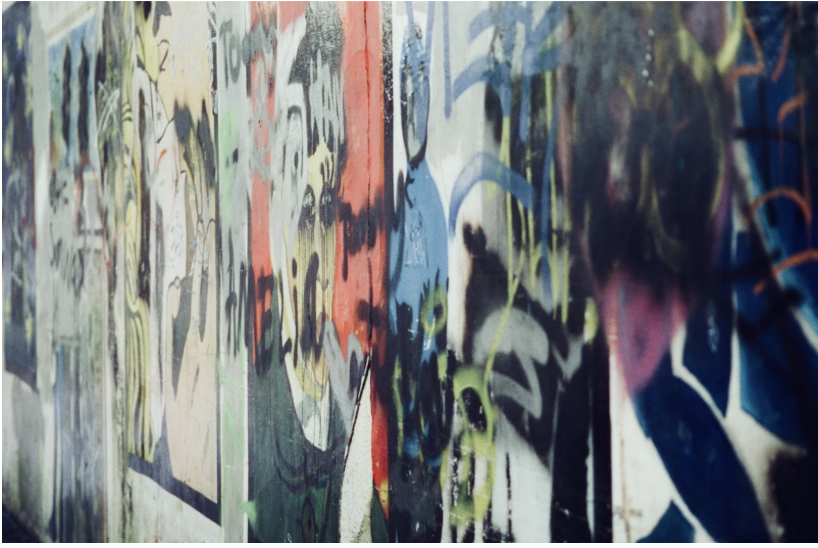
Over time graffiti has emerged, overlaying the original pieces. A rare sight of organic expression on Ringwood’s walls. Much of it is tags, with little explicit political or social messaging, and yet in the context of this rural town this layer is transformative. Following Quill Kulka’s notes on transformative graffiti, it serves as a small yet visceral window into the inhabitants and story of our town. It actively places an unsanctioned identity into Ringwood, transforming how the space can be interpreted and who gets to express or make their mark. The canvas has been poorly maintained - stale water droplets cover the tunnel’s ceiling threatening to fall on those passing through, black mould creeps from the corners and there is a distinctively loud hum from the road, yet the presence of street art and graffiti here suggests to me that this is a place I can engage with and not only walk-through.
Photograph by Billy Cook, 2026
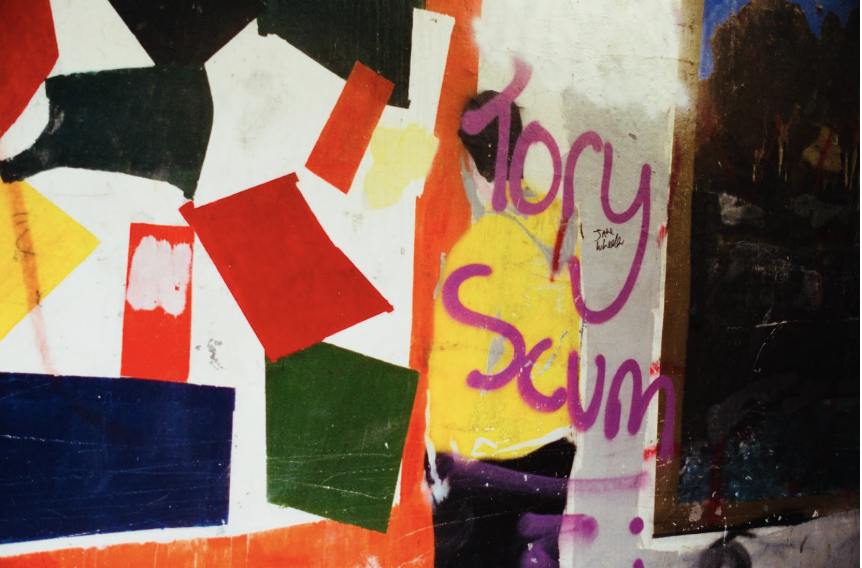
With a more explicitly political tone, graffitiing “Tory Scum” in a Conservative stronghold is a deliberate act of political dissent. It inherently involves risk and feels actively confrontational and unscripted compared to the council-sanctioned pieces which are managed and safe. Political messages stand out in this rural setting where in a city it may be saturated with politically motivated tags. The piece has not been removed or covered in the many years it has been in the ‘Walk of Art’, its persistence could suggest a quiet agreement from the community, a benign neglect or that it is simply tolerated. Seeing this as we walk through the tunnel differs from political messaging we see online or on television precisely because it is localised and physical. It is unavoidable in this space and shown to all, no matter your online echo chamber. This piece is an example of unsanctioned expression transforming the space.
Although scarce, I know graffiti is continually popping up around town as evidenced by the freshly painted grey squares, deliberate redactions of pieces perhaps deemed unsuitable for Ringwood’s identity. Large sections of the ‘Walk of Art’ have been covered in the council’s signature redaction grey (though they manage to avoid the student’s artworks). I’m pacing the tunnel searching for a piece I distinctly remember seeing at fourteen. “Free the Nipple” written on the walls of the ‘Walk of Art’ taught me something about my body, not only how it was contested or reclaimed on a wider social scale, but how those politics could and do exist within my local, immediate environment. I related to it and felt seen by it, encountering a political position embedded directly into the physical space of my everyday life. This seemingly small inscription altered how I understood my body and my town. It introduced a global conversation into my small rural context. I can’t find it and assume this graffiti now sits beneath grey paint - a token of bodily liberation deemed unfit for Ringwood’s identity. It seems the council is quick with their grey too! They are currently caught in tom and jerry style fight with a graffiti artist by a roundabout from one of the entrance points to the town. There is an electrical box on the side of the road which has ‘ACAB’ written on it, but never for long. It will pop up and then be greyed out, and pop up again not long after. This is a local painting duel, graffiti theatre.
Ringwood is a small rural-town in England that lacks organic, bottom-up street art or graffiti. When we do see street art it is generally commissioned, decorative and arguably identity-neutral. The overpainted layers of graffiti in the ‘Walk of Art’ become especially meaningful, as they are rare moments of unsanctioned public expression. Here, we are invited to see how people relate to their town, community, politics and bodies in a way that commissioned art does not. Perhaps in rural towns, it is the scarcity of street art and graffiti that makes it disproportionately significant as a site of place-making, self-expression and political consciousness, revealing local identity. If you took space, on a large blank wall, what would you want to express to your rural town?
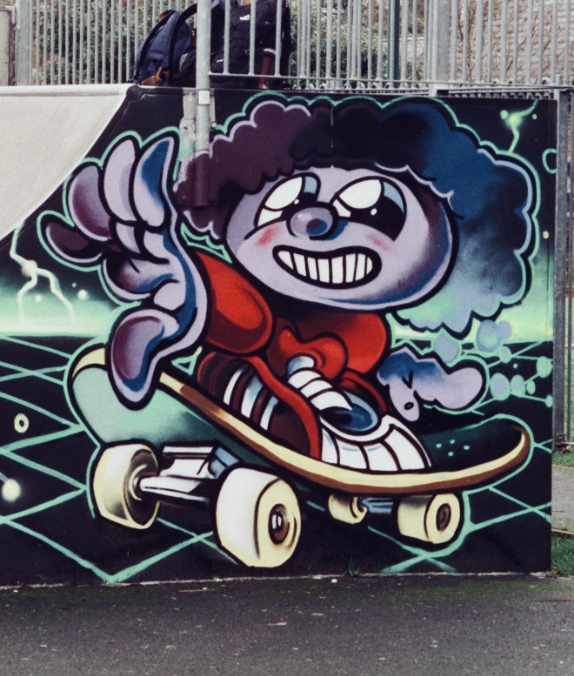
Photograph by Billy Cook, 2026. Art by @MBNARTS
Written by Bella Rix
Photography by Billy Cook (@thisisbillycook)



Recipe