“The Liberties”: Exhibition held by Gearoid Simms - Simms Offers the Version of Ireland That Was Never for Sale.
In recent years, a wave of Irish culture has washed over England. Bands such as Fontaines D.C. have paved the way to the forefront of public consciousness, and Guinness-themed t-shirts now line the racks of fast fashion haunt Urban Outfitters. They are worn as an ode, of sorts, to one's affinity for the culture, and the prowess at “splitting the G” that accompanies it. The band and the drink share more than a country, however, because both belong to a single neighbourhood, The Liberties, in inner-city Dublin. It is both the birthplace of Guinness, founded in 1759, where Fontaines met as BIMM students and wrote “Liberty Belle” in dedication to a pub in the area. Grian Chatten once described this song as “a lament to the death of old Dublin”, written by the people who “couldn't afford the new one”. This narrative is not specific to, but reflective of The Liberties, as a working-class corner of Dublin that is now being repackaged as something more “developed”, and, for lack of a more accurate word, gentrified.
It is that older Liberties, the one buried somewhere beneath the distilleries and the listicles, that Gearoid Simms has set out to paint. The “expressive surrealist” artist grew up there, and his “deeply personal” new collection, which opens on 17 September at the Island Gallery on Bridewell Street, charts those years. Having watched the area transform from an intimate place bound by story, community and shared spirit into somewhere almost unrecognisable, he has devoted considerable time, and no small amount of artistic licence, to painting it as he remembers it. While The Liberties that has travelled to England is, for the most part, an outsider's Liberties, The Fontaines came to it as students and left it as a band. The t-shirts are printed a long way from St James's Gate, and National Geographic stayed just long enough to file a piece anointing the place “the Brooklyn of Dublin”. Simms grew up inside it, and encapsulates what made the area so unique - its people.
The concept for his exhibition began somewhere unremarkable, on the floor of a friend's bedroom, listening to Abbey Road. There, Simms began to draw parallels between his own neighbourhood and the places the Beatles had so dearly written into their songs. Lyrics and artistic concept moved in tandem, both circling street names, the faces both familiar and less so that walked them, and a shared, nostalgic sense of a place that would go on to change beyond recognition. His own work reaches for the same thing, a single moment built from many intersecting ones that brings the Liberties, in all its vibrancy, to life across his canvases.
Central to all of this, and unmistakable across his work, is the theme of memory. Simms describes the figures his art gathers around as “Hogarthian”, by which he means atmospheric and “dreamily lifelike”. His reading of that style leans into nostalgia, a looking-back with no exact clarity but one that homes in on what stood out. The characters, accordingly, are accentuated rather than rendered accurately. One central work depicts a tiny Jewish man who used to sit on Cork Street, given a walking stick so disproportionately large it makes him look comically small. The buildings around him are left deliberately sparse, stripped of the detail lavished on the figure, so that the bricks and mortar, ironically the very things now being “developed”, end up mattering far less than the man who sat among them. Time has passed and the area has
blurred in his memory, and the paintings seem untroubled by it, because they were never really about getting the streets right. They are about the stories, and the people who used to tell them.
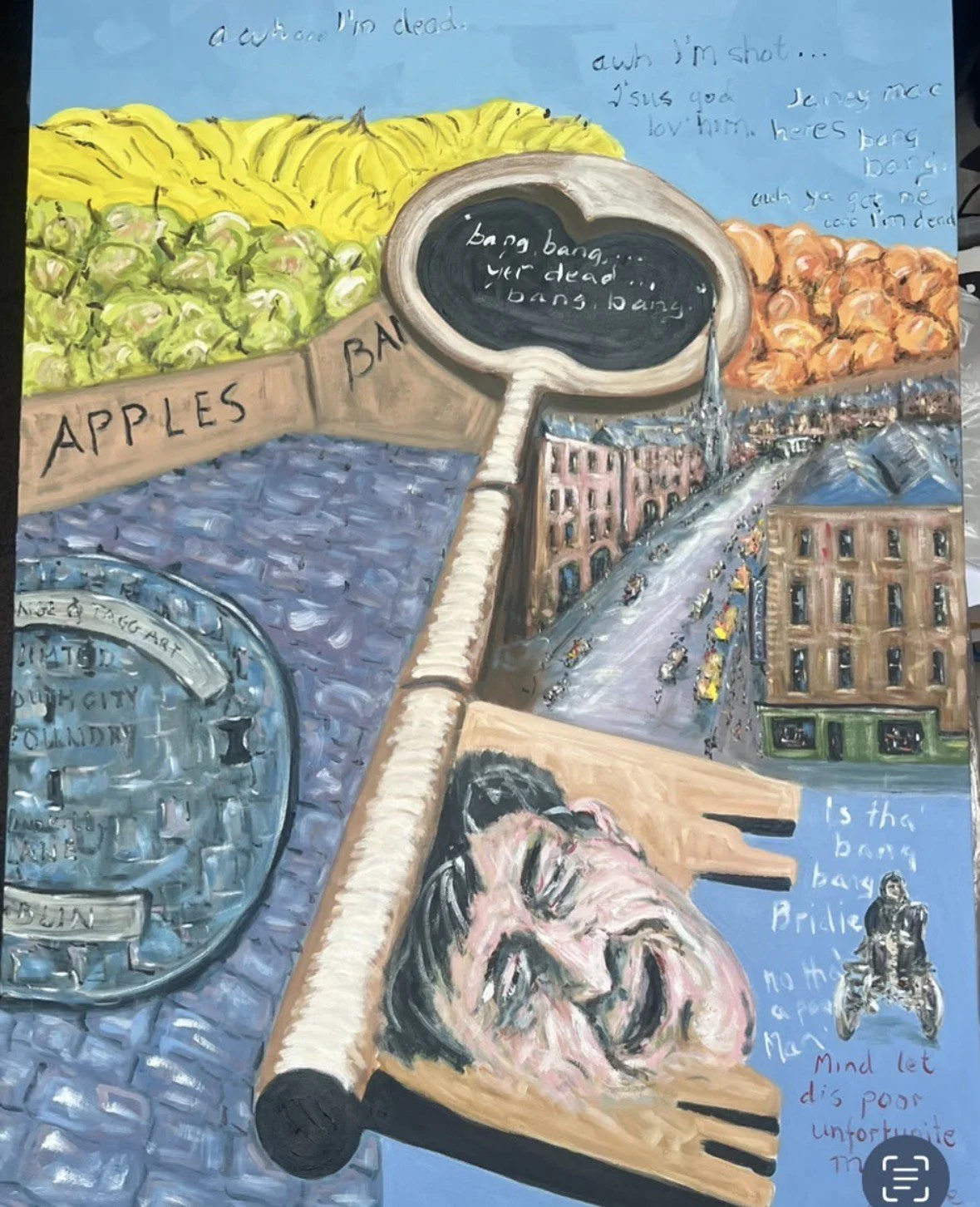
Simms gives the same treatment to “Bang Bang”, or Thomas Dudley to give him his proper name, a fixture of Dublin folklore who, for years, cheerfully terrorised the city with a brass church key. He would leap onto the backs of trams and buses, brandishing the key like a pistol and “shooting” passers-by while the whole street played dead. He lived most of his life on Mill Lane, in the heart of the Liberties, and was, they said, the last of the great Dublin characters. Simms hands him an entire canvas, the key blown up to heroic scale and the air around it thick with the scraps of that shared performance. Awh I'm shot… bang bang, yer dead… mind, let dis poor unfortunate man. It is a portrait of a man, and of a city that once knew how to stop and play.
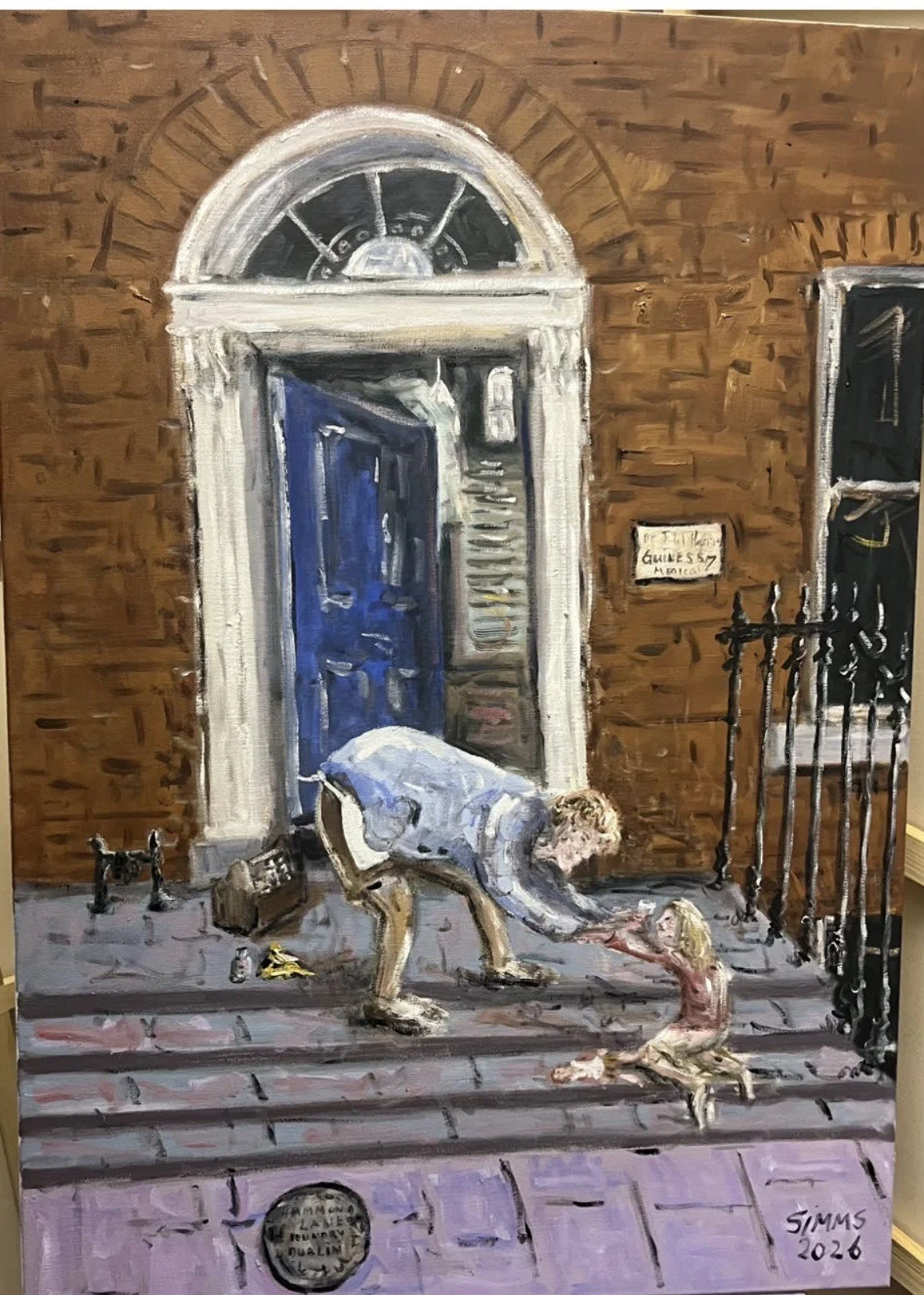
Paddy, hung nearby, is a sadder story. He hauled a box across the neighbourhood, up to the dealers and back, day after day, until the box became the man. “Is that your house?” people would call after him. “Is that your coffin?” Legend held that he died on the job, still dragging it.
Where Bang Bang is remembered with a laugh, Paddy is remembered with a wince, and the two hang together as a reminder that the characters a place romanticises are often the ones it failed.
Simms is showing the work in the South West of England, where he trained professionally at Bath, a long way from the Liberties and further still from anyone who would have known Bang Bang, or Paddy, or the man on Cork Street. Nobody walking into the gallery will recognise a face. Yet the paintings encapsulate one very particular place so completely that they do not need the viewer to have been there, and they speak for themselves. To an English audience meeting Irish culture largely through pint-glass slogans and sold-out gigs, Simms offers the version that was never for sale. If you want to see the Liberties in all its glory, and meet the people who made it, it is hanging on Bridewell Street from 17 September!
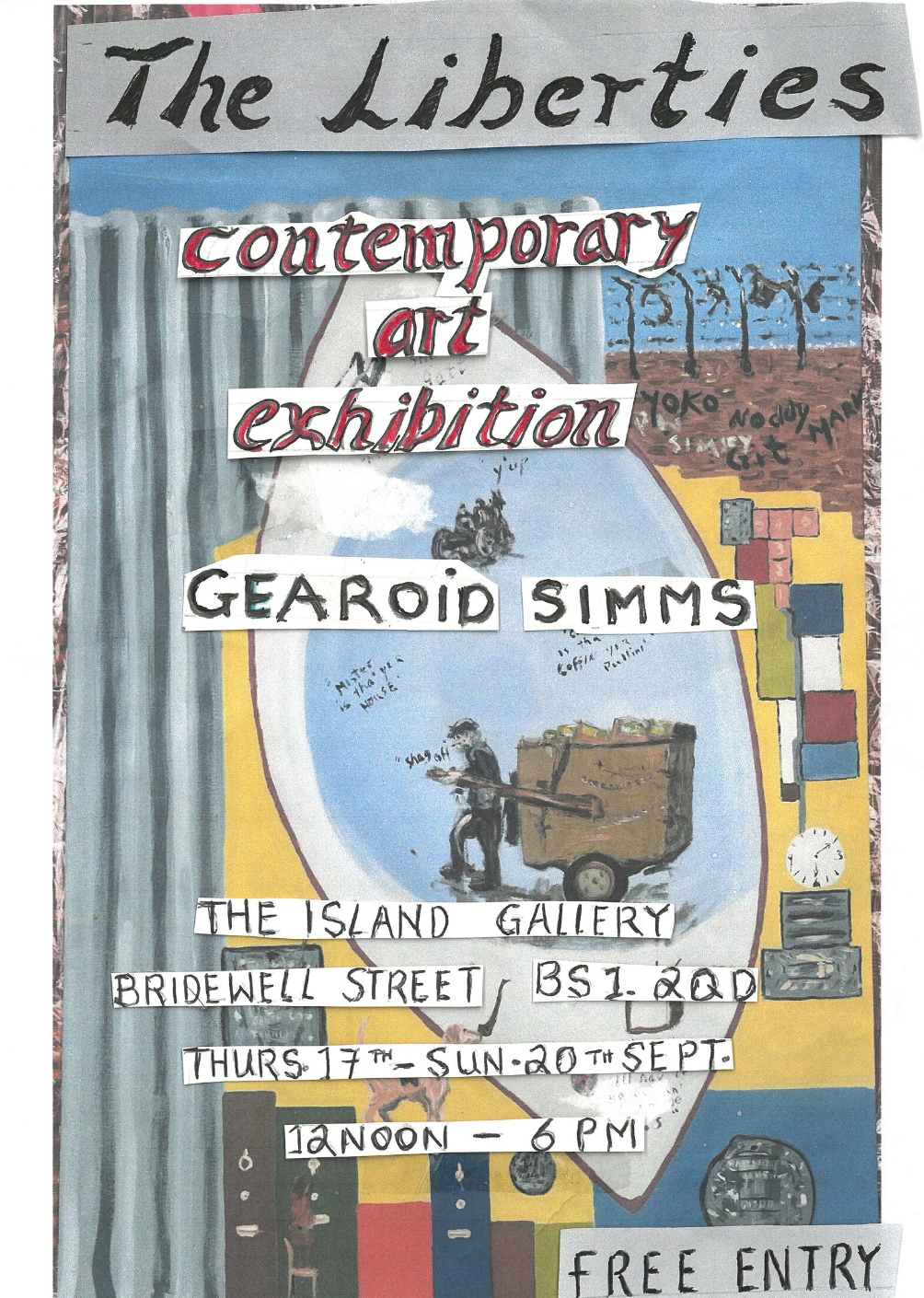
For details on the exhibition, you can go to Headfirst. Tickets are free.
Written by Claudia Spice

Recipes